Skip to content
Home / About Sandra
Voice and Speech
Coach. Inspiring
Performer.


Entirely transformative.

Sandra McKnight has spent more than three decades helping professionals discover a voice that feels authentic—and sounds impossible to ignore.

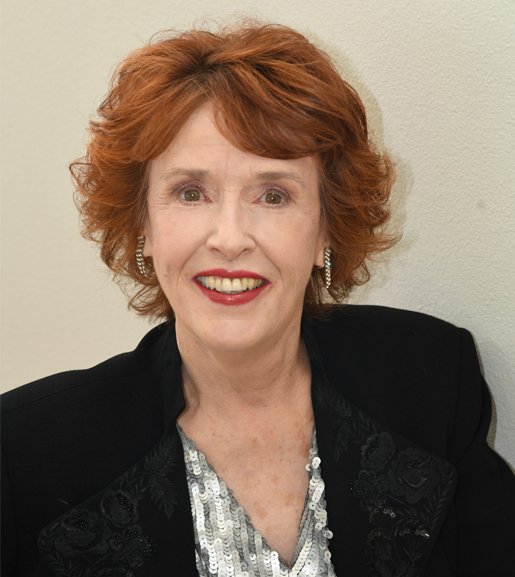
Sandra McKnight

International voice & speech coach
The voice behind Voice Power

A Performer’s Ear. A Coach’s Clarity.

Sandra has coached executives, entrepreneurs, and professionals for more than 30 years through her signature training, “Your Voice Is Power in Business.”

Her clients have included leaders and teams from Intel, Microsoft, Nestlé, Google, Facebook, and many other respected organizations. She has delivered more than 2,000 keynotes, workshops, seminars, and tele-seminars across the United States, Australia, and China.

In 1986, Sandra founded Voice Power Studios to bring together voice, improvisation, performance, creativity, and practical business communication. Her work helps people connect technical skill with the human qualities—energy, emotion, confidence, and presence—that make a voice memorable.

“Charisma is made, not born.”

Sandra McKnight

Twenty years on stage and screen

Performance experience that changes the room.

Before bringing performance tools to business, Sandra worked as an actress, singer, dancer, and comedienne in New York and Los Angeles.

Her acting credits include General Hospital, where she played Nora Phillips, as well as The Young and the Restless, Lou Grant, The Bold and the Beautiful, and Divorce Court. She appeared in more than 250 commercials, earned a CLIO Award, and built an extensive voiceover career.

Sandra began as a professional dancer, performed comedy improvisation in Chicago, Dallas, and Santa Fe, and toured European venues with ITI. Her one-woman show, The Magical Energy of Happiness, brings together her love of voice, humor, performance, and human connection.

Training & teaching

Technique with depth.

Sandra earned her BA from Penn State and studied voice, diction, and communication at Juilliard. Her acting teachers included Lee Strasberg, Uta Hagen, and José Quintero, and she studied singing with New York City Opera baritone Richard Fredericks.

She has served as an adjunct faculty member at the University of New Mexico and Santa Fe Community College and has long supported Toastmasters members in becoming more expressive, confident speakers.

Credentials & professional community

A career built across coaching, education, and performance.

EDUCATION

Penn State & Juilliard

BA from Penn State with advanced study in voice, diction, and communication at Juilliard.

MEMBERSHIPS

Industry connected

Member of VASTA, SAG-AFTRA, and Actors’ Equity Association.

MEDIA

Recognized expertise

Featured by The Wall Street Journal, Houston Chronicle, Los Angeles Times, Santa Fe New Mexican, and Albuquerque Journal.

Articles & press

Voice Power in the news.

Los Angeles Daily News: Want to communicate more effectively? This Coach can help.

Want to communicate more effectively? This Public Speaking Coach can help.

By Kevin Smith, San Gabriel Valley Tribune

In the world of business, effective communication is key.

When a CEO or chief financial officer gets up to give a presentation, it’s imperative that the information be delivered clearly, concisely and with confidence.

But what if you end up racing through the presentation, glossing over key points and ultimately losing everyone’s attention?

That’s just one of many scenarios speaking coach Sandra McKnight is familiar with. McKnight offers speech coaching and accent reduction techniques to senior executives, sales managers, customer service representatives and others who want to become better communicators.

“A lot of people come to me because they had a performance review and were told that they speak too fast or that they’re not being clear,” she said. “They are not speaking succinctly and are talking around subjects. Sometimes they are repeating themselves and using filler words like ‘um’ … and ‘OK’ because they’re not sure what they’re going to say next.”

Others might mumble or speak in a monotone voice thatt is guaranteed to put listeners to sleep.

Speaking coach, McKnight offers a variety of programs through her Voice Power Studios that are designed to correct those problems. She provided an overview of the most popular one.

“I offer eight sessions that are taught every two weeks over the telephone, so it’s highly convenient,” she said. “Each session is 75 minutes long. They call in and I record it and then send it to them afterward with a written summation.”

Clients are taught how to properly project and support their voice and how to speak at a pace that best conveys the information they are trying to present.

Robab Safa-Bakhsh, who manages technology research projects for Boeing, is one of McKnight’s clients. She frequently collaborates with others in and outside of her company in such locations as Southern California and Seattle.

“I’m from Iran and because of my heavy accent I needed to know how to pronounce words,” she said. “She also helped me with other aspects, such as voice control which is very important. I have a strong technical background and there are a lot of concepts I understand in my work, but I had a hard time communicating them. Sandra is very effective in what she does.”

The Wallstreet Journal: How to Train Your Voice to Be More Charismatic.

 Scientists Analyze Public Leaders’ Voices to Discover the Basis for Charisma
PUBLISHED ONLINE In the Wall Street Journal – Original Blog

Researchers are discovering how charismatic leaders manipulate their vocal qualities to rouse people to action. WSJ’s Robert Lee Hotz and Tanya Rivero discuss.
Photo: Getty
By ROBERT LEE HOTZ 

Scientists are tuning in on the power of the spoken word, seeking the secrets of charisma. By analyzing the harmonics of pitch, frequency and timbre, researchers at University of California, Los Angeles are discovering how charismatic public speakers use their voices to dominate, rouse and influence a large audience. They are finding that successful politicians in various countries, including Italy, France and Brazil, all share key vocal qualities that strongly affect how people respond to them, independent of the meaning of the words they say or the ideas they express.

In a separate analysis of some prominent business leaders, the researchers also found charismatic patterns in the public speeches of Apple Inc. Chief Executive Tim Cook and the late Steve Jobs.

Train Your Voice to Be More Charismatic

For speech experts, the voice is an instrument of rare persuasive power, tuned by evolution and culture to communicate far more than words alone convey. Some people are just born with the charismatic qualities that dominate or inspire trust, but voice researchers are confident that at least some of these acoustic elements can be taught.

You have the capacity to shape your voice in a way that makes people perceive you as a leader,” said UCLA acoustic scientist Rosario Signorello, who conducted the charisma experiments. He presented his work recently at the annual meeting of the Acoustic Society of America in Indianapolis. “It applies to politicians, to CEOs, to everyone who aspires to leadership status.

CORPORATE VOCAL CHORDS
Your voice can help or hinder your business career. Researchers at Duke University’s Fuqua School of Business analyzed speech patterns of 792 chief executives at major publicly held companies. Male CEOs with lower-pitched voices:

  • Tended to manage larger companies.
  • Made up to $187,000 a year more than higher-pitched peers.
  • Lasted as many as five months longer as the head of a firm.

Of course, leadership in any field is more than just noise. Not all successful businessmen, for example, displayed charismatic patterns in public speeches, according to the researchers’ analysis.

In politics and business, public speaking is especially influential. Voters, for instance, tend to favor political candidates with deeper voices, several studies suggest. CEOs with lower-pitched voices typically manage larger firms, make more money and last longer on the job than higher-pitched peers, studies at Duke University’s Fuqua School of Business have found.

“There must be markers in your innate voice,” said Duke University accounting professor William Mayew, who studied how vocal pitch can affect employment prospects, firm management and the trustworthiness of financial reporting. “You don’t just get emotion, but you also get information about the type of person you are dealing with.”

These nonverbal signals can occasionally reveal more than intended. By analyzing speech samples of CEOs recorded during corporate earnings calls with investment analysts, Dr. Mayew identified involuntary vocal cues that signal the likelihood of financial misreporting.

The new research into charisma arises from efforts to understand the relationship between vocal acoustics and the psychology of perception. “Our voice transfers our essence to others,” said speech physiologist Bruce Gerratt at UCLA’s Voice Perception Laboratory. “Some of it is intentional, some of it is unconscious and some of it is biologic.”

Generally, researchers believe that the voice conveys volumes about social status and power, but efforts to document the acoustic profiles of such effects are controversial. Subtle changes in the biomechanical interplay of the throat, tongue, vocal folds and larynx, caused by disease, aging, stroke or injury, can alter the voice in subtle ways that, in turn, can change how listeners respond. But researchers investigating the psychology of acoustics haven’t yet been able to pin down cause and effect.

“How are these physical changes linked to perceptual changes?” said Jody Kreiman, an expert in voice perception at the UCLA David Geffen School of Medicine’s department of head and neck surgery who wasn’t involved in the charisma project. “Everybody says this is subjective and can’t be measured, but that’s nonsense.”

In his experiments, Dr. Signorello analyzed recordings of speeches by leaders speaking French, Italian and Portuguese, including François Hollande, the current president of France, and Luiz Inácio Lula da Silva, a former president of Brazil. He also studied speeches given by two Italian politicians, Umberto Bossi and Luigi de Magistris, and by former French President Nicolas Sarkozy.

To isolate acoustic properties, Dr. Signorello used a speech synthesizer to eliminate the actual meaning of the words being spoken. The frequency, intensity, cadence, duration and other vocal qualities remained intact.

Then, to understand how acoustic traits affected perceptions, Dr. Signorello and his colleagues asked 107 female and 26 male volunteers to rate a speaker’s charisma on a scale using 67 positive or negative adjectives, ranging from eloquent and bewitching to egocentric and menacing. To ensure that only perceptions of vocal qualities were measured, they also had the Italian speeches rated by 48 people who didn’t speak Italian, and the French speeches rated by 48 people who didn’t speak French.

Generally, someone speaking in a low-pitched voice is always perceived as big and dominant, while someone speaking in a high voice is perceived as small and submissive. When speaking to crowds, the political leaders typically stretched their voices to extremes, with a wide range of frequency variation, Dr. Signorello said.

“In the three languages, I see a similar pattern,” he said. “My research shows that charismatic leaders of any type in any culture tend to stretch their voice to the lower and higher limits during a public speech, which is the most important and risky context of communication for leadership,” he said.

These leaders adopted an entirely different tone when speaking to other high-ranking politicos or when the subject strayed from political topics. “They stretch their voice less when they speak to other leaders, keeping the vocal pitch very low. They stretch the voice limits even less when they speak about nonpolitical topics,” Dr. Signorello said.

In one experiment, he found he could change the way people perceived President Hollande of France by artificially dialing the pitch of his voice up or down.

Aspiring executives should take note, Dr. Signorello said. “The voice is a tool that can be trained,” he said. “Singers and actors train their voices to reach higher or lower frequencies. A leader-speaker should do the same.”

So far, he has only tested male voices. Given gender-based differences in the larynx and vocal folds, the characteristics of charisma he has identified so far may not apply to how women speak. He has started collecting speech samples for an analysis of female leaders.

Maybe there is a charismatic voice just for women,” Dr. Signorello said.

Deliberately lowering the voice to resemble the sound of a successful male voice, though, can backfire, Duke University’s Dr. Mayew discovered. Young women who adopted a distinctive low, guttural way of talking that linguists call “vocal fry” were perceived as less competent, less educated, less trustworthy, less attractive and less hirable.

Voice Coaching Builds a Successful Career... In Better Management Magazine for the Management Development Center of Hong Kong

Voice Coaching Builds a Successful Career

Printed in Better Management Magazine,
By the Management Development Center of Hong Kong
Text by Sandra McKnight

Effective communication and presentations is key to doing business successfully in today’s highly competitive market place. In the business world today, salespeople, managers, VPs and CEOs are expected to be outstanding communicators and presenters. It is the primary way for them to distinguish themselves on the long list of equally qualified competitors.

Content alone does not carry the day. It is the emotional connection you make with people that is critical for persuasion. Presentations are crucial to laying the groundwork for a good mutually productive business relationship.

Let’s think about why some people move more quickly along their chosen career path, successfully influence and motivate others or make more sales. Is there any mystery ingredient in their presentation style? Yes! Voice Coaching! Effective voice training can insure that you make a powerful human connection with your listeners every time you speak.

When you are presenting, negotiating, selling, networking or interviewing, more than half of your communication success rate depends on using your voice and words effectively. That statistic rises when communicating by telephone. Technical and intellectual prowess and creativity combined with a confident voice that persuades, motivates and inspires can make you an outstanding communicator in your chosen field.

Simply stated, perception is everything. The way you sound, look and act is whom people think you are. Everyone is perceived in one-way or another. Voice coaching gives you the power to change or enhance the way you are perceived. With voice training, you have the power to control the impression you create.

Please take a moment to review this simple Executive Speaking Skills Self-Assessment. The following questions are designed to help you decided if you feel your speaking style is working effectively for you.

1. Do you feel that your voice projects power and self-confidence? Yes/No
2. Do you have energy and enthusiasm in your voice? Yes/No
3. Does your voice resonate authority and believability? Yes/No
4. Do you keep 90% of your listener’s attention when you are speaking? Yes/No
5. Do you know how you sound and the effect your voice has on others? Yes/No
6. Does your voice convey your thoughts and emotions accurately? Yes/No
7. Do you speak too fast or too slow? Yes/No
8. Do you speak too loud or too soft and timidly? Yes/No
9. Do you speak in a boring monotone with no excitement and vitality? Yes/No
10. Is your pronunciation clear and easily understood? Yes/No
11. Do you appear preoccupied and nervous sounding? Yes/No
12. Do you use a lot of filler words? Like, so and Un Huh? Yes/No
13. Does your voice engage the hearts, mind and imaginations of the listeners? Yes/No
14. Are you earning the respect and trust of your business colleagues and the public by communicating effectively/ Yes/No

If you find you can use some help in improving your communication, here are a few handy Executive Voice Coaching Secrets that will enhance your speaking style.

• Achieve clarity and credibility by pronouncing all consonants clearly.
• Build audience content retention by speaking between 140-160 words per minute.
• Increase your volume by projecting your voice one foot beyond the listeners.
• Project an energetic/confident voice by breathing in and speaking out on the exhale.
• Create a positive impression by not trailing off at the ends of your sentences.
• Convey your meaning quickly by emphasizing the “power words” in each phrase.
• Use the “Pause” as a replacement for the “Uh-huh” and “ums”.
• Engage your audience by speaking in short phrases that have rhythm and flow.
• Communicate dynamically and expressively by adding colorful adjectives and descriptive phrases that make your ideas come alive in the mind of the listeners.

I am very appreciative of having the opportunity to work with executives in Hong Kong and would like to share two success stories with you.

I first went to Hong Kong because a young, rising Chinese executive, who was working for an American company based in Hong Kong, contacted my website asking for voice training.

“I offer voice coaching by telephone nation wide in the US, and I am happy to teach you in Hong Kong, I said. You realize there is a 14 hour time difference.” “ No problem,” said this determined man who wanted to work with a teacher that had an American accent. “Here in Hong Kong our English teachers are either British or Chinese who have learned English from British teachers, he said. I work in an American company and I need to speak English with more of an American accent in order to be easily and readily understood by my colleagues and to advance, my position within the company. “ He also stated that he was looking for a way to communicate and present that would allow him to work in a western business environment without losing his cultural authenticity.

To me this was an exciting challenge. I told him that my philosophy is that the way you are perceived is who people think you are. Based on their perception of you, people decide whether you are sincere and if they wish to do business with you. Now in any given set of circumstances, the way you choose to use your voice, your body language, your word choice and intentions determines the way they perceive you. It is all about your choices.

He had all the management training, business training, and he was an expert in his chosen field. I felt sure that developing his communication skills would help him reach his career goals. Communicating more clearly required 4 months of voice and diction coaching. He learned how to use consonants effectively, to improve his English grammar, to employ phrasing to put the heavy stress on the correct syllable in a word, to emphasize the power of words in his sentences and to develop an American speech rhythm, to name a few of his new speaking skills.

After he had laid the groundwork, he asked me to come to Hong Kong to help him finish building his speaking style. He introduced my services to a training organization in Hong Kong and I was hired to train in Executive Voice and Speaking Skills.

I was excited to have the opportunity to see him give a live speech and to help him with the next step which was improving his body language. Finally I said, it was time for him to emotionally connect to the audience: to let his energy and excitement for his message draw the audience into his speech.

“This is the how you are going to persuade them to listen and to buy, I said. We all know that one sells the benefits of the product but if you are not showing me how excited you are about the benefits of the product, how can I believe in what you are saying?”

“Let me give you an example of another American executive who had a similar situation – In his speech, he was talking about the benefits of a hypothetical hotel room. He spoke of the rooms’ “pure luxury” and how the bathrooms had glass-enclosed showers designed to make the guests feel special.”

“You are being corporate and safe, I told him. I want you to take risks with your speech.” He tried again….”The room is done in a rich teak wood that is just magnificent. And with a touch of a button you can have an incredibly beautiful view.” “Yes! Now I am interested in you and your hotel,” I said joyfully.

The point of this example is that you are the message. The client can’t become enthusiastic about the hotel room until you make it come alive in their imagination. I know you are interested to know that my client has been successfully promoted to the marketing director within his American company.

Another of my clients from Shanghai is the president of a growing Chinese Company. We met at an international conference where I was speaking on the powerful role the voice training plays in communication. “In the coming year, my bushiness plan calls for me to grow my company by giving numerous speeches to promote our services world wide and I feel that your voice training can help me,” she said.

She sent me a video of some of her past speeches. Most of them were in English or Mandarin and in both languages her speaking style was the same. Her stumbling block was that she expected her audience to listen. She spoke as if the audience was there only to hear the factual information she was giving them and based on that information they would make up their mind.

“Of course they want the facts, I said. However, in order to sell them on your services, you need to connect with them emotionally in some meangful and powerful way. You need to demonstrate through the power of a captivating story and your own passion and enthusiasm for your services that your company is the one they need to hire.” I continued. “You are just talking to the audience and hoping they will listen. You need to project the volume of your voice in every way. Instead of just talking you need to totally engage their mind, hearts and imagination.”

I suggested we use her speech to take the audience on a journey: a journey filled with many exciting, dynamic and relevant examples, anecdotes and statistics. Together we improved her word pronunciation, and she learned to emphasize the “powerful and descriptive” words in each of her thoughts, which in turn allowed her to connect her enthusiasm and energy with her factual content.

She was so pleased with the results of her next speech. “Now people are involved, she said. They are excited about the possibilities I am offering them.” She knew that she was engaging her audiences and that as a result that they trusted her, the head o f the company, to do what she was saying she could do…She experienced the power of her voice to persuade. As a result her company is steadily moving ahead in the world market.

Sandra McKnight is a professional actress and the owner of Voice Power Studios located in Santa Fe, New Mexico, USA and a leading expert in the Art of Voice and Executive Speaking training. If you find the subject matter interesting would like to master the skills, please send your name, email address and phone number for an update of Sandra’s September workshop in Hong Kong.

Contact:

Sandra McKnight
Voice Power Studios
1-877-783-2455
1-505-466-6500
sandram@voicepowerstudios.com

Voice Training Is Key To Getting Your Message Heard... In Business, Sales, and Politics.

Voice Coaching, Key To Getting Your Message Heard

… In Business, Sales, and Politics

Political hopefuls, business executives, sales people, and others who live and die by the spoken work learn that effective speech training is the first step towards getting their message heard, says speech coach Sandra McKnight. A highly respected voice communication consultant and founder of Voice Power Studios, McKnight points to ‘performance-oriented’ speech training and presentation skill development as a critical first step for anyone seeking to project a dynamic and charismatic public persona.

When most people prepare to give a speech, whether it’s in the political arena, a crowded boardroom, or even a one-on-one sales pitch with a client, they tend to center on perfecting the content of their remarks. “But what they say may never be heard,” observes speech training specialist Sandra McKnight. The reason? “People will tune out the message if they don’t like the sound of the voice that’s delivering it,” says speaking coach McKnight.

Knight is no stranger to the power of the voice. She made her living “off my voice and my wits,” she says, for more than three decades. A sought-after speech training and presentation skills consultant, she is the creator of the “Your Voice Is Power in Business” audio series and the founder of Voice Power Studios. Her clients include a who’s who of iconic companies and brands worldwide, including Chase Manhattan Bank, Frito Lay, and Cedars-Sinai Hospital Ernst and Young, Asia; Hong Kong.

Accelerate the Learning Process
In order for a message to reach its audience – whether a room full of sales executives or a single customer — “A speaker must first create a listener-friendly ‘delivery system – and by that I mean an appealing and effective voice,” says speech trainer McKnight. “There’s a reason Chrysler chose Ricardo Montelban and not PeeWee Herman as their spokesman to talk about Corinthian leather,” she laughs.

McKnight’s distinctive “performance-oriented” executive speaking training programs expand on the basics of good presentation skills to serve the needs of “success-minded individuals seeking both professional and personal empowerment,” she says. Her speech training helps CEOs, senior management and sales professionals work on tone and timbre, and to “communicate with clarity and confidence in any business-speaking context. My goal is to make my clients feel confident about speaking whether they’re in a formal presentation situation, having a one-on-one with a customer, on the phone conversation with a client, or a meeting with a vendor,” says McKnight.

Techniques for using the voice for maximum effect “take time to master,” reports McKnight, “But there are two ways to accelerate the process.” First she recommends finding a speech training professional who offers “a program for learning that’s “tailored to your specific needs, and abilities. That will save you time and money.”

Vocal coaching “makes it easier for you to learn how to ‘play your ‘instrument’…how to use your voice…effectively,” says McKnight. A good coach will “assess your strengths and weaknesses and will design a training program to make you more powerful,” she says.

Tips to Stay “In Shape” For Speaking
Caring for your instrument is part of the process, and “hydration is key,” says McKnight. For traveling speakers, she recommends a visit to the steam room or sauna in a hotel healthclub. “It’s very therapeutic for your voice after a long day of speaking.”

To create an in-home equivalent, speech trainer McKnight advises clients to “inhale steam from a bowl of water with a few drops of eucalyptus oil.” Other moisture-friendly tips include:

  • Maintain body hydration by drinking plenty of water throughout the day. “Avoid caffeine and carbonated drinks as they drain your tissues of essential fluid, “say McKnight.
  • Use a humidifier to keep your vocal chords and sinuses from drying out, especially in dry climates.
  • Keep your throat moist by drinking lots of tea with honey and lemon when available and having throat lozenges in your pocket when it’s not

About Sandra McKnight and Voice Power Studios
Sandra McKnight is a highly respected voice communication consultant and speech trainer and creator of the “Your Voice Is Power In Business” voice training CD series. She has 25 years of cross-cultural experience in speech training and communications and has worked with business professionals throughout the world. She also has 35 years experience as an actress, on stage and in film and television. McKnight merges the worlds of business and performance to provide speech training services that enable her clients to become top performers in their unique industry, whatever it may be.

Speaking coach McKnight’s expertise has been featured in the “Wall Street Journal”, “The Houston Chronicle”, “Los Angeles Times”, “Santa Fe New Mexican”, and “The Albuquerque Journal” and for many years hosted her Santa Fe, NM radio show, the “Sounds of Success”. She is a member of The Voice and Speech Trainers Association, Inc., The American Society of Training and Development, 24-7 Coaching, UK, The Screen Actors Guild of America, Actor’s Equity Association, and the American Federation of Radio and Television Artists.

For more information about Sandra McKnight and Voice Power Studios dynamic coaching services or to order “Your Voice Is Power In Business,” please visit http://www.voicepowerstudios.com/

Contact:

Sandra McKnight
Voice Power Studios
1-877-783-2455
1-505-466-6500
sandram@voicepowerstudios.com
SanRafaelPatch: Job Tips from the Experts

Helpful advice on career goals

and the power of your own voice.

By Robin Collins

Everybody is talking about jobs. All over the country. From the president on down to those of us who sit in San Rafael coffee shops. How to get one. How to keep the one you have. How to enter the work force. How to get back into the work force. Age discrimination.  How to find your dream job. I hate my job but am afraid to quit because I might not find another.

And the burning questions: What do I really want to do with myself? What fulfills me?

So I decided to run a several part series on jobs. The first of my articles  discusses some things the experts say we should think about even before we answer an ad on Craigslist or go to an interview, in person or online, even before we seek help from an employment agency.

Consider the following questions:

What do you really want to do?

What kind of first impression do you make?

Today, I introduce two local experts I interviewed recently. Heidi Kraft is a career coach and Sandra McKnight is a voice coach.   Perhaps you have never even thought about either of these services. If you are unhappy in your present career, or not getting second interviews, perhaps you should.  These are both successful, savvy, and results-oriented women who are ready, willing and able to offer advice and expertise on landing a job in today’s market.

Kraft Your Success

Heidi Kraft, who founded Kraft Your Success, believes that everyone should love the work they do. Kraft Your Success helps individuals find what they do well, so they do it better and enjoy it more.

Her company helps teams work better together. And helps organizations maximize productivity and foster the kind of professional fulfillment that leads to a healthy, creative and dynamic workplace.

“The last couple of years have been difficult to find employment. We are all aware of that,” she said.  “But I am seeing a significant increase in the number of jobs out there.  More importantly, however, people are realizing that there is less security with any job they take.  So that brings a great opportunity for individuals to take a step back and figure out what they really want. This is where the Kraft Your Success one-on-one coaching approach is very effective. We help you craft your own unique path so that you love the work that you do,” she said.

“The process we use is to help you:

IDENTIFY what it is you really want.

BELIEVE you can successfully achieve your dreams, goals and successes.

KRAFT a specific action

PLAN to reach your goals.

MOVE you forward with consistent momentum.

CELEBRATE your victories.”

Kraft’s clients move toward their goals much more quickly with a coach to cheer them on,  because they are accountable on a weekly basis to what it is that they want to achieve.

“We’ve helped people in many industries to successfully transition from a corporate career to entrepreneur, achieve the next level ‘dream’ job, navigate promotions or become more well-rounded in the leadership role or work past obstacles in order to create a clear path to the work they are meant to do,” she said.

And best of all, Kraft offers a complimentary consultation so you have nothing to lose and perhaps a great deal of fulfillment to gain.

www.kraftyoursuccess.com/blog – for more information

Your Voice is Power in Business

Successful people know that how you communicate is as important as what you say.

According to a study published in Psychology Today, the sound of your voice is much more important in making a first impression than what you actually say.

Sandra McKnight, who lives part time in San Rafael and part time in New Mexico owns Voice Power Studios.  After much research in the field of business and effective communication, McKnight has concluded that how you sound is who people think you are.

“An essential ingredient that gives you the competitive edge in today’s job interview market is a voice that conveys confidence, authority, self-assurance, persuasiveness and trustworthiness,” she said.

“Most of the initial interviews are conducted by telephone or on the computer through services such as Go To Meeting, and you are being critiqued on the way you sound and speak. It can make the difference as to whether you get to the next interviews,” she said.

Among other things, she helps people have “an executive presence”, increase sales, and project the confidence to be promoted.

Besides being a voice and communication consultant and trainer, McKnight is also a professional actress and comedienne who speaks worldwide on “Your Voice Is Power In Business” and “Charisma is Made not Born!”

McKnight has delivered more than 2,000 keynotes as a corporate keynote speaker, workshops, seminars and tele-seminars throughout the United States and China.  Her powerful voice and presentation ideas, fast-paced humor and charismatic presence always receive high evaluations.

She is off to St. Louis in early February to work for Nestle Purina PetCare doing an all day workshop for their Sales and Marketing Women’s Leadership Conference.

Check her website for details on receiving a complimentary voice analysis.

If you prefer to work on your own, on her website you will also find “Your Voice Is Power in Business” MP3’s, which have extensive voice exercises.

www.voicepowerstudios.com – for more information

If you are a job seeker, or thinking of changing careers, or if you just want to be more powerful in your own business life, I hope you have found this article a helpful start. Tomorrow I will pass on more advice from the pros about getting job in today’s market.

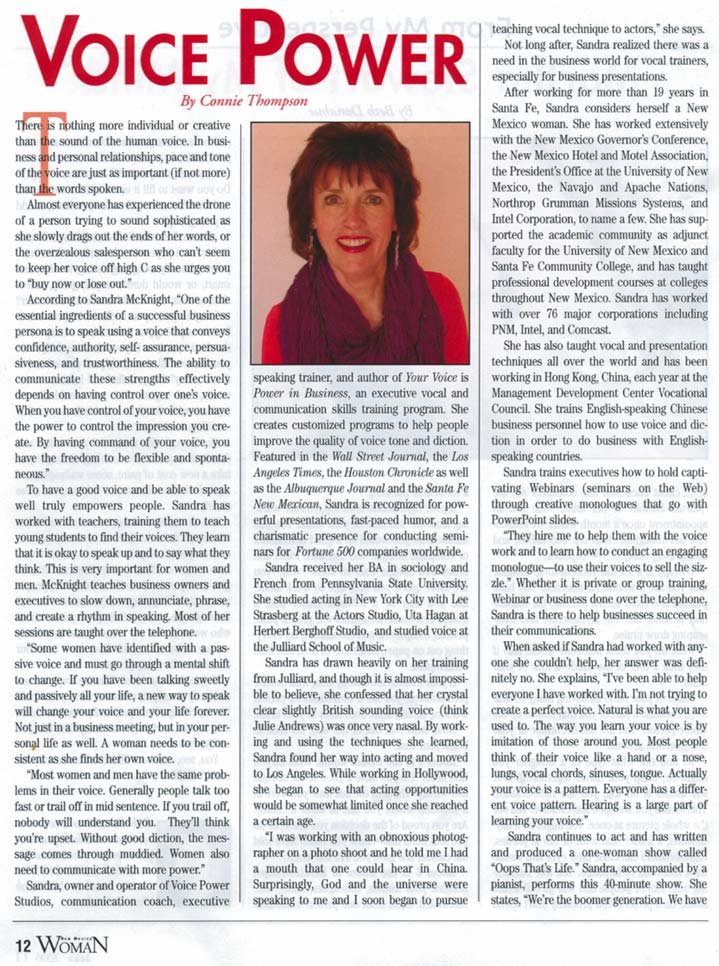
New Mexico Woman: Voice Power.

Sandra McKnight featured in New Mexico Woman Magazine

The Wallstreet Journal: A Personal Trainer for Your Voice.

Featured in

Section D

A Personal Trainer for Your Voice

By JENNIFER SARANOW


   VINYA LYNCH HATES the sound of her voice. She thinks it is timid and sing-songy. She blames it for why she is frequently cut off giving presentations at work, and for why it takes her as many as 10 tries to record a voice-mail message.
   “When I listen to myself, it doesn’t sound intelligent,” says Ms. Lynch, a 35-year-old handbag designer.
   So last summer, simply to change how she sounds, Ms. Lynch began seeing a speech pathologist. Total cost: $2,250 for 10-sessions plus evaluation, text and tapes. “I want my voice to be charismatic and confident all at the same time,” she says.
   Speech therapy used to be for stutterers, lispers and other people with medically diagnosed language problems. But in a culture increasingly devoted to personal trainers, self-help books and cosmetic surgery, a new outlet for self-betterment is emerging: the personal voice trainer.
   Eager to boost their prospects professionally or socially (or both), a growing number of people are hiring speech pathologists to “tone” and improve normal voices. It’s a phenomenon driven partly by the tight job market, where every little advantage counts, as well as the pervasiveness of cellphones and voice mail, which can amplify the eternal tendency to cringe at the sound of one’s own words.
   “This is not speech therapy, this is beautification of the voice,” says Ita Olsen, a speech pathologist in New York whose firm Oslic Consultants LLC sees about 275 individuals a week for “cosmetic” voicechanging, compared with about one per week three years ago.
   Technological advances are making cosmetic voice changes easier. A number of speech-therapy practices are using digital video endoscopy, a technology that allows speech pathologists to see the vocal folds as they are vibrating — and to home in on what the talker is doing wrong. (It involves sticking a small fiber-optic tube with a camera at the end up the patient’s nose.) Others use a computerized system that quantifies speech. Patients speak into a microphone and a line appears on a computer screen that reflects their pitch, loudness and vocal quality. The number provides a quantitative baseline voice from which doctors can work.
   But speech therapists are also finding low-tech ways to capitalize on the growing

market. Sandra McKnight, a voice coach in Santa Fe, N.M., offers voice training over the phone (a typical treatment program is four 75-minute phone sessions for $640). She says she doesn’t have to see patients in person to know what their voice problems are; she just needs to hear them. Susan Miller, a Washington, D.C., speech pathologist, and Susan Berkley, a voice expert in Englewood Cliffs, N.J., recently released a compact disc package, available through the Internet (www.voicetrainer.com), called “Vocal Vitality: A safe, easy warm up program to energize and enhance your speaking voice” with morning vocal exercises for unsatisfied talkers. They’ve sold several hundred so far.
   Dr. Miller says the growing demand for voice improvement became apparent to her in the fall of 2002 when she gave a six-week course at the Smithsonian called “Cultivating the Medium of the Message: Your Voice.” She expected about 30 participants at the first class. More than 150 showed up. “I was shocked,” says Dr. Miller, who estimates about 35% of her 120-patient-a-week practice now is devoted to training normal voices, up from 5% three years ago.
   People have been wincing when they hear themselves speak since the dawn of the recording. Common complaints run the familiar litany of too high-pitched, too monotone, too nasal, too much like the opposite sex. For women, they often include: too shrill, too “valley girl,” or too faint. For men, familiar grievances are too gravelly or too weak.
   Voice experts say that many voice “problems” are caused by unbalanced talking, or using too much of one part of the voice. (The components of the voice include breathing, vocal chord vibration and the sound of the voice as it resonates out of the mouth, nose and throat.) For example, hypernasality results from letting sound resonate too much through the nose. A gravelly or harsh tone comes from excessive tension in the throat area.
   The voice “is very similar conceptually to a person’s knee,” says Joseph Stemple, a speech pathologist at the Blaine Block Institute for Vocal Analysis and Rehabilitation in Dayton, Ohio, and author of a well-known voice pathology textbook. “It can become strained and weakened and unbalanced and you can do direct exercise to enhance it.”
   The key behind most voice exercise programs is teaching patients to find their “true” sound when emphasis isn’t on

one part of the voice over others. Patients learn to breathe from their stomach and let the voice carry more fully out of their mouth. They learn to feel whether they are exerting their mouth, nose or throat too much when talking. They use relaxing exercises to relieve tension that may be putting emphasis too much on one area.
   Patients say that the end result is a better voice and more-effortless talking — but getting there takes a lot of work. Learning to talk with a “true” voice can mean anything from figuring out how to hold your tongue while speaking to breathing differently — movements that feel weird and unnatural at first. It takes extensive practice to turn such changes into habit.
   “The results are largely dependent on the amount of energy that they are willing to put into their practice,” says Kate DeVore, a speech pathologist from Chicago, who estimates that personal training of normal voices now accounts for about half of her practice.
   It requires not only practice, but a substantial amount of money, usually between $100 and $200 per session. Group sessions, which Dr. Olsen in New York has dubbed “voice spas,” cost less.
   Ms. Lynch says the gain has been worth the pain. At her third session with Dr. Olsen this past summer, Ms. Lynch relaxed her head from side to side, took a few breaths and practiced saying phrases she utters daily such as “40th and Broadway” and “two tickets please” using her new “true” voice.
   A few weeks ago, she finished the last of her 10 sessions. Her new sound is deeper, slower and stronger than her regular voice, thanks to relaxing her throat muscles more to let air out and figuring out how to use her tongue differently.
   “I learned a lot in theory and now, it’s just a matter of applying it,” she says. For now, she’s mostly practicing around strangers — when she orders coffee, for instance, or gets in a taxi. But one day at work, she decided to use her new voice — or as she prefers to call it, her “natural voice” — all day. Everyone asked, “‘Why are you speaking that way?'”

       — The Wall Street Journal Online


Wall Street Journal Journal Link: WSJ.com
subscribers can listen to examples
of voice and speech techniques at

WSJ.com/PersonalJournal.

The Wallstreet Journal: The Campaign Against 'Like.'

Featured in

Section D

The Campaign Against ‘Like’

As Ex-Valley Girls (and Boys) Move Up the Ladder, Pressure Grows to Sound Professional

By ANDREA PETERSEN


   IN SUZANNE Loudamy’s house, the word “like” is under siege.
   When her 18-year-old daughter, Sarah, speaks, Ms. Loudamy holds up her hands to count how often the word leaves her mouth.
   “My mom talks about how it’s not, like, professional and says I’ll look stupid,” says Sarah Loudamy. “But someday everybody my age will be in the professional world with me. If they’re saying ‘like’ too, I won’t stand out.” Two decades after the song “Valley Girl” popularized it, a fresh effort is afoot to stamp out this linguistic quirk. The generation that grew up saying “like” is hitting adulthood and the work force. As a result, it is now in the lexicon of investment bankers, doctors and even teachers, where it can sound especially jarring. “I’m sure I say, ‘like’ a lot,” says Liza Sutherland, 28, a sixth-grade humanities teacher in New York. “I don’t worry so much about how my students speak.”
   Like a verbal virus, this usage is also increasingly spreading to other English-speaking countries. British and Canadian kids now grease their sentences with the word. Sali Tagliamonte, professor of linguistics at the University of Toronto who has researched the speech of the elderly in the United Kingdom, found that they, too, have a surprising fondness for “like.” “If I showed you a written document of the conversation, you would think they were young women in North America, not 78-year-old ladies from Scotland,” she says.
   The battle, of course, isn’t being waged against traditional uses of “like” — the ones that express an affinity (“Mikey Likes It”) or compare two things (“My love is like a red, red rose”). What’s targeted is the repetition of “like” that to critics sounds like nonsense. Example: “Like my mother is like a total space cadet.” (From the lyrics to “Valley Girl.”)
   Linguists say “like” has a growing number of meanings. It can act as a “hedge,” to tell the listener that what is being said is an approximation or an exaggeration. (Example: “She has, like, a gazillion shoes.”) It can also be a “focuser,” to declare that the next bit of information is important. (“He is, like, so hot.”) One of its most ubiquitous uses is as a substitute for “said.” (“So my mom was like, ‘Do your homework.’ And then I was like, ‘I did it at school.'”)
   There is a range of tactics to combat all this. Some parents

mimic their kids and “like” them right back. Fed-up English teachers are turning their classrooms into “like”-free zones. Even speech pathologists are being called in to help break the habit, at rates of as much as $100 an hour. One common tactic: tape recording or videotaping the afflicted as a kind of shock therapy to show them how “like”-infused they really are.
   In one exercise at Leap Learning Systems, a language school in Chicago that offers after-school and summer programs to help inner-city kids master “standard business English,” students are asked to shout “beep beep” whenever a speaker in the class uses “like,” among other words, unnecessarily. Katie Schwartz, a speech pathologist in Chattanooga, Tenn., has a more Pavlovian technique. Her “Sense Cues” kit trains speakers to associate the smell of something they don’t like with remembering to delete superfluous “likes” from their conversation.
   When the “likes” start spilling from the mouths of Vickie Bunting’s students, she writes their sentences on the blackboard and has them read the words back. “It will click and they’ll see it doesn’t mean anything,” says Ms. Bunting, who teaches high-school English in Lubbock, Texas.
   Language watchers offer various theories to explain the spread of “like.” Some blame declining emphasis on grammar instruction in schools. Others point to an explosion of slang in music and movies, making nontraditional speech more widespread and acceptable.
   Defenders of the practice argue that these usages are just a natural evolution of the English language. Indeed, even some linguists say the word can be downright useful. When dropped into the middle of a sentence, for example, it gives the speaker time to gather his thoughts so he doesn’t say the first (sometimes insipid) thing that comes to mind. Studies also show that people who have learned not to use filler words are interrupted more often, and tend to use simpler sentences.

   “It really is a wonderful, useful word,” says Muffy E.A.Siegel, an associate professor of English at Temple University in Philadelphia, who has studied the use of “like.”
   Valley Girls weren’t the first group to find some other uses for “like.” Jazz musicians and beat poets used it as a filler word in the 1950s — as a substitute for ‘um’ — according to linguists. In the late ’70s in Southern California, the word for the first time started turning up, in popular form, to introduce a thought or bit of speech.
   This form of “like” was unveiled to 


Like ‘really is a wonderful, useful word,’ says one professor of English.


youth culture with the song “Valley Girl” by Frank Zappa and his then-13-year-old daughter Moon Unit. A decade later, “like” with a form of the verb “to be” was voted the phrase “most likely to succeed” by the American Dialect Society, a group that studies American English.
   And succeed it has, judging by the frequency with which it still pops up in conversations. In a University of Alberta study, which involved 30 Americans ranging in age from 14 to 69, a couple of the participants used the word more than 100 times in a half-hour conversation. The study found that, while younger people used it more often, all age groups employed the Valley-girl-type “like.”
   Indeed, while the stereotypical offender may be a 15-year-old suburban girl who twirls her hair and works at the mall, some studies show that boys are now just as likely to abuse the word.
   Some of the “like”-dependent just end up reaching a compromise of sorts. Justin Slay, a 15-year-old in Lubbock, Texas, says whether or not he uses it depends on whom he is with. “Girls say it in almost every sentence,” Justin says. “I don’t say it when I’m talking to guys.”

SantaFe New Mexican: Article with Sandra McKnight New Mexican Voice Coach

Featured in

Eldorado Edition Page 5

Teacher helps students gain respect changing their voices

By MICKEY ROGERS
For The New Mexican


   Do you have an IQ of 150 but just can’t seem to get any respect?
   Eldorado’s Sandra McKnight of Voice Power Studios suggests changing your voice. McKnight teaches seminars and workshops nationally to business executives and other professionals who want to improve their ability to communicate and control the impression they make on others.
   She has an impressive client list, including The University of New Mexico, the U. S. Coast Guard, Sprint, Public Service Company of New Mexico and the American Telemarketing Association.
   McKnight explained that success in life depends on how you present yourself through appearance, actions and sound. Your ability to communicate has a profound effect on how others perceive you, she said.
   “It’s not just what you say, it’s how you say it,” McKnight said. “Your voice can convey many things: self-assurance, persuasiveness and trust-worthiness. And those things contribute to one’s success in life. For example, if you have a weak or nasal voice, or a tendency to speak too quickly or to mumble, you cannot expect to have the same impact as someone who imparts a clear, confident and authoritative image.”
   This was certainly the case in her own experience. A native of Pittsburgh, Penn., McKnight experienced her first taste of rejection while auditioning for an off-Broadway role in New York City.
   “A director told me that I had talent, but my voice was too nasal,” she said. “Like most people I didn’t realize how I sounded.”
   After studying voice at Juilliard in New York, McKnight moved to Los Angeles and spent many years as a successful actress in Hollywood. She appeared in over 200 commercials and made several appearances on various soap operas and television shows. Her most notable role was as Nora Phillips on General Hospital.
   About 14 years ago, McKnight began to sense a decline in roles for women who were no longer in their 20s and 30s. A friend suggested she start a voice class for actors. She expanded her prowess by studying body language and communication and developed a series of seminars and workshops for professionals as well as lay people. Eventually, she broke into the business

Jane E. Phillips/The New Mexican  
Sandra McKnight of Voice Power Studios teaches workshops to  
professionals who want to change their speaking voices.  

world, created a business named Your Voice Via the Telephone and began training telemarketers.
   Corporate accounts followed and despite her move to Santa Fe, her business continued to thrive. In New Mexico, her services have been employed by Los Alamos Laboratory, Intel, the New Mexico State Department of Taxation and Revenue, the New Mexico Association of Counties, First National Bank of Santa Fe and Santa Fe Properties.
   “Communication is 55 percent body language, 35 percent voice and only 10 percent words,” McKnight said. “When companies are vying for contracts the person who best presents themselves has the leading edge. But the same is true in social situations. You attract others according to what you project.”
   McKnight teaches several different workshops. Change your Voice, Change your Life is a popular course scheduled quarterly at the Santa Fe Community College. It includes instruction on articulation: speaking more clearly and distinctly, putting power in your voice, building skills for effective presentations, projecting confidence and a rich, authoritative voice and increasing vocal flexibility and making your voice come alive.
   On Nov. 15, Your Voice is Power in the Business World, another seminar, will be held at the Petroleum Club in Albuquerque. It includes a professional voice analysis, role playing exercises to shape the impression you make, taking control of the non-verbal messages you

send, freeing yourself of vocal anxiety and learning to communicate more effectively.
   On Nov. 16, McKnight will hold a seminar at the Governor’s Conference called The Theater of Life, inspired by Shakespeare’s analogy, “all the world is a stage, and men and women are merely players.” This seminar explains how to create a more dynamic presence in the workplace by using acting and improvisation techniques. McKnight uses costumes and props to demonstrate how people assume different images.
   “Acting gives you tools and teaches you skills,” McKnight said. “Just as an actor develops a character on stage, in real life you can learn how to develop your own persona and project the image you want. You can develop a better sense of who you are and how to present yourself more effectively in different circumstances.”
   McKnight also teaches Voice Production, a class which educates actors, broadcasters and T.V. personnel on the use and care of their voices. The next course will be held during the Spring semester at the Santa Fe Community College.
   She has also developed a one-woman show called Oops! That’s Life! The show consists of a series of comic monologues common to all which she performs in whole or in part at luncheons and dinner events.
   For more information on Voice Power Studios call 466-6500 or visit the Voice Power Web site at www.voicepowerstudios.com.

Albuquerque Journal: You Don't Need to Keep the Voice You Hate


Sage Magazine Page 5

NETWORKING       Specifically… news for women

You Needn’t Keep The Voice You Hate

   Many of us hate our voices. Too soft, too little-girl-sounding. But we think there’s nothing we can do about it.
   Not true, says Sandra McKnight, who is conducting a workshop called “Change Your Voice, Change Your Life” from 8:30 a.m. to 4:30 p.m., July 29, at the Albuquerque Petroleum Club, 500 Marquette Ave. NW.
   “Most of us just adopted the voice we heard one of our parents use,” McKnight says. “In some cases, we started speaking very softly because Mom was an alcoholic and wanted everything very quiet.
   “On some level, people realize it’s not their voice — on a technical level and on a ‘who-am-I’ level. It doesn’t feel like the right voice.”
   McKnight, a voice teacher and actress (you may have seen her as Nora Phillips
on “General Hospital”), says a motivated person can change her voice in six or seven sessions. The workshop is a start and can make an immediate difference; often small group classes develop afterward.
   “The voice is the megaphone of the soul,” says McKnight. “The way you sound at any given time is who people think you are. When you have control of your voice, you have the power to control the impression you create.
   McKnight speaks from experience. At her first audition, when she was trying to break into acting, the director barked at her: “Miss McKnight, please come down off the stage.” She did, and he said, “If you want to work in this business, get rid of that voice.”
   She burst into tears, but the director told her not to worry, just to go find a
voice teacher at Julliard in New York. She worked seriously on changing her voice and successfully got rid of what she called her nasal, Pittsburgh accent.
   McKnight started teaching voice to actors in Los Angeles about 10 years ago and was soon asked by some businesses to work with their telemarketers. When sales took off because of improvements in voice and speech techniques, the word quickly spread. Since moving to New Mexico, McKnight has worked with such businesses as Intel, US West, the University of New Mexico President’s Office, as well as individual clients.
   The cost of McKnight’s workshop is $150 and includes a catered lunch. To register, call 466-6500 or e-mail sandram@voicepowerstudios.com.
                          — Polly Summar
Houston Chronicle: Creativity.


Section D★★

Creativity Public Speaking Article, Houston Chronicle

Can it be taught? What
a negative question


   By CLIFFORD PUGH
   Houston Chronicle


   Ketia Francis is walking around with a five of clubs on her forehead, and she doesn’t like it.
   The Hogg Middle School teacher feels out of place because she sees that others in the room have a nine or 10 on their foreheads (the highest number available because the face cards have been removed from the deck).
   Francis picks another card and, though she doesn’t look at it, she knows it’s high by the nicer way the others treat her.
   Seeing that she’s a 10, they raise their energy level to match hers. They’re suddenly more confident, outgoing and full of life.
   “When you’re out in the world, you need to go out as an eight, a nine or a 10,” explains communications specialist Sandra McKnight. “If you’re going for big gains, you have to go with all you’ve got.”
   Walking around with cards on their foreheads is more than a silly game for Francis and the others. It may be a start on the road to unleashing their creative power.
   McKnight and others at the ninth annual convention of the American Creativity Association, which is taking place at the Westchase Hilton through Saturday, believe everyone has the potential to be creative.
   “It’s like any sport. No matter what level of competency you are at, you always get better with instruction and learning techniques,” says David Tanner, president of the nonprofit organization dedicated to increasing the importance of creativity in our society.
   There are many different ways to learn to be creative. Tanner, the author of Total Creativity in Business and Industry, favors a technique called “lateral thinking” that tackles a problem in an impractical way to come up with a new idea.

   For example, a seminar for high school students and teachers focused on the idea of “How can we make learning in the classroom more fun?”
   Wishful thinking led one of the students to say, “Let’s get rid of the teachers.”
   The off-hand comment sparked a spirited discussion that led to a creative way to tackle the problem. The group decided that once a month, a student or team of students would take turns conducting the lesson and the teacher would become part of the student group.
   “Once you get outside your normal pattern of thinking, you go out in new directions,” says Tanner.
   McKnight, an actress and communications specialist who teaches seminars around the country on the art and power of creative communication, favors performance techniques such as improvisation and focused concentration taken from the acting world.
   She believes anyone can learn to be creative if they open up and become more willing to take risks.
   “First you have to have a willingness or an interest in being more creative about life,” she says. “That means you have to overcome your fears of it.”
   In a workshop prior to the start of the convention, McKnight led a group through a series of games such as throwing stuffed animals in syncopated time and mirroring each other’s movements to encourage spontaneity, observation and dealing with energy and all the senses.
   The session ended with team improvisations to get the group to begin learning to think quickly on their feet.
   “What we’re trying to do is to get you to open up to the process of creativity,” she says. “The only way I know to do that is to participate in some kind of creative activity.”
   She encourages those who are timid about the creative process to first start with a fun physical activity, such as yoga or dancing lessons.
   “Do the things that are fun for you, so that you open your physical willingness to do things,” she says. “This begins to work with the mind, because once you open up physically, you start to open
emotionally and mentally.”
   “Then begin to take any kind of risk that allows you to move out of your comfort zone,” she says. (She favors taking an improvisation class at a local comedy club as a way to improve creative powers.)
   “Nike is making millions of dollars selling shoes by telling people, ‘Just Do It’ because most people don’t just do it,” she says. “People just don’t have the energy or the cultural reinforcement to be creative. Our society does not support creativity, originality or risk-taking.”
   Dale Clauson, a Houston board member of the American Creativity Association and co-chair of its convention, says it’s not surprising that most people are afraid to be creative because the first reaction to any new idea is usually negative.
   He says when you ask a kid, “What do you think of my idea?”, most responses are positive. But by age 16, half will respond negatively and half will respond positively.
   By the time that person has reached adulthood, he or she is likely to discourage creative thinking. More than 85 percent of adults will tell you what’s wrong with the idea rather than offer any positive feedback.
   So Clauson, who heads a company called Strategic Innovations that helps corporations attack problems with creative thinking, keeps a piece of paper in his wallet with the letters P.I.N., which stand for “positive”, “interesting” and “negative.”
   When someone presents an idea, he looks at its positive aspects before getting to ways it could be improved.
   “I say something like, ‘It’s a good idea. I like it.’ Then we get to the point of ‘Have you thought about doing this?’ That addresses the negative in a positive way.”
   Clauson also cites research that indicates the average child asks 143 questions a day whereas the average adult asks only six questions a day.
   “Creative people are the ones who keep questioning and are positive about their ideas,” he says.
Computer TELEPHONY: How to Choose the Voice of Your Company.

Featured in

Page 208

How To Choose The Voice Of Your Company

That computer telephony system you have in the office probably has the
“voice” most heard by your customers. That makes it a powerful member
of your company.
     Here are some things to consider when you select the voice for it.

Does the voice project the image of your company? Your company has a personality. A voice can communicate that personality to your customers. The voice representing a bank shouldn’t sound the same as that of a cruise line. Trained talents are usually better at projecting personality than somebody you’ll find in accounting or the president’s wife.

  • Look for a neutral accent. This might depend on your app. If you’re only
    fielding calls from a particular region, an accent might not be a problem. For
    national or worldwide apps, it can turn callers off.
  • Pick a voice that sounds professional, clear, friendly and caring. Since
    words are limited, the voice must carry these impressions to the customer.
  • Find somebody who speaks rhythmically. Flowing speech is easier to
    take and understand than choppy speech.
  • Look for inflection. A voice with expression will engage callers. A monotone
    voice will bore them.
  • Select a voice that clearly enunciates all of the consonants and vowels.
    Listen carefully, especially if you’re not using a trained voice.
  • Make sure the ends of sentences aren’t thrown away. Sometimes a
    sentence will start with great inflection and then taper off. You lose the
    customer with the lost end of the sentence.
  • Avoid nasal, monotone, mumbling, too slow, too fast, harsh, loud, very deep
    or very high voices.
  • Listen to the voices on tape or, better, in a test run in your computer
    telephony system.
    Some voices do not sound the same recorded as they do live.
  •  

      — Sandra McKnight, president of Voice Power Studios (Santa Fe,
  NM — 505-466-6500); Sandra will be one of the speakers for the CT Expo
  ’97 seminar presentation titled “Artistry & Sound Production: Rock Solid
  Success Tips From the Experts” on March 6th, 1997 at 11:30 AM, Track Six.

SantaFe New Mexican: Voice coach says you are what you sound like.

Featured in

Business of Santa Fe Section — Page 14

Voice coach says you are what you sound like

Helps people to ‘get
what they want’


By RUTH LOPEZ
The New Mexican


“It is not of so much consequence what you say, as how you say it.”

                          — Alexander Smith
                        Essayist (1830-1867)

                      ⊕   ⊕   ⊕

   Sandra McKnight knows how the power of voice can change your life.
   The Santa Fe voice coach left her native Pittsburgh after college to become an actress in New York. After her first off-Broadway audition the director told her that he felt she had talent but if she didn’t “lose the nasal” she would only play “hillbillies.”
   Like most people, McKnight didn’t know what she sounded like. The kindly, but direct, director told the stunned actress to go to Juilliard. So she did. For two years McKnight studied privately with a voice coach there.
   The short story: She lost the nasal, moved to Los Angeles, played commercials and soaps.
   Eight years ago — finding fewer and fewer roles for women — McKnight began to consider career alternatives. On the advice of an industry photographer, she started a voice class for actors and discovered she was good at it.
   More classes followed and eventually she got a contract to train telemarketeers. That was her first foray into the business world — and not her last. More business accounts followed, a few that brought her to New Mexico.
   Two years ago she moved to Santa Fe.
   Now McKnight runs a business — Voice Power — out of a small

office on Galisteo. Her goal, she says, is empowerment. “I want people to get what they want out of life. When I was nasal no one paid attention.”
   McKnight believes business professionals can be more successful by training their voices to project confidence, self-assurance and credibility. Just looking at her client list you can see many businesses agree with her. Since arriving in Santa Fe, McKnight has worked with First National Bank of Santa Fe, Santa Fe Properties, New Mexico Association of Counties, Packards and the state’s Taxation and Revenue Department, to name a few.
   McKnight discovered that she wasn’t just teaching voice, she was teaching communication skills.
   When it comes to success in sales, 55 percent is determined by posture, 35 percent is voice and 10 percent words, McKnight said. And we all know the adage, “It’s not what you say — it’s how you say it.”
   “There are a lot of negative voice patterns, that turn someone on or off,” McKnight said, ticking off a list of them — mumblers, talking at people, monotone. “I ask salespeople if they would buy from one of these people.” And the answer is always no.
   The idea, McKnight said, is to have a personal relationship with everyone. To some, this might
seem like training in phoniness. But to McKnight, it is a way that people can learn not to get in their own way. “The voice is the megaphone of the soul,” she said. “The way you sound at any given time is who people think you are. If you mumble you can be seen as insecure, passive, maybe even manipulative.”
   McKnight credits much of her approach in teaching voice to her show business background. For example, “When Lena Horne turns on that voice she grabs a hold of your ears. Energy makes your voice alive and when you have a voice that’s alive you turn other people on.”
   “I use my acting skills to help people change attitude.”
   McKnight maintains a busy schedule. She has a radio show on KSFR (90.7) Your Voice is Power; in addition to private coaching lessons she teaches a course at the Santa Fe Community College, Change Your Voice, Change Your Life. And she hasn’t given up acting. McKnight is currently at work developing a one-woman show.
   But she has found tremendous satisfaction in helping people. “If you have control of your voice you have control over what you project out into life. You have choices, therefore you get more of what you want,” said McKnight.
   “The body and the voice never lie. You really know who people are if you listen and if you watch.”
Los Angeles Times: Changing Your Voice Can Make You a Winner, Says the Experts.


Thursday, February 2, 1989 Page V1

Changing Your Voice Can Make You a Winner, Say the Experts

By KATHLEEN DOHENY


   You can dress for success, master the zen of office politics and learn how to win friends. But if your voice is too low, too high or too soft, sought-after promotions or personal relationships may still elude you.
   That’s the opinion of a number of speech therapists who believe the voice is an overlooked tool, one that can make or break careers as well as relationships.
   Though few are born with great voices, speech patterns can be improved, say therapists who have devised a number of strategies to make the task easier. Besides a host of recent books on the topic, there are at-home instruction tapes and vocal coaches who charge from $75 to $300 per hour to help transform sloppy voices into suave ones.
   Whether you choose the do-it-yourself route or hire a consultant, experts agree the first step to a better voice is finding your natural pitch.
   Los Angeles speech pathologist Morton Cooper believes there may be two pitch levels in every voice, an optimal or natural level and a habitual one.
   To find the proper pitch, Cooper recommends an exercise called the instant voice press. “Standing, place your index finger just under your sternum (where your ribs come together). Now press gently with a staccato movement and make sound with the lips closed.” Saying “ummmm-hmmm” can help, adds Cooper, author of “Change Your Voice, Change Your Life” (Harper & Row).
   Proper breathing – from the midsection of the chest – is also important, Cooper says. “Most women breathe with the upper chest,” he finds, partly from habit. “Their mothers told them, ‘Hold in your stomach.'” That may be good for the profile, he adds, but it impairs effective speaking.
   Those basics down, correcting bad habits becomes the issue, say speech therapists, who often differ in their approach. Here are some of their suggestions for correcting problem voices:
   Nasal. Don’t think you are? Deborah Ross, a Santa Rosa speech pathologist, suggests this quick test: Touch the sides of your nose when you speak. “If it vibrates, too much air is passing through the nose, causing a nasal quality to your speech,” advises Ross, who has devised a three-part instructional audio

tape for home use (Voice Advantage, 170 Sotoyome, Suite 2, Santa Rosa, Calif. 95405).
   Nasal speakers often don’t open their jaws wide enough, adds Glass. Move the voice forward, suggests Cooper. “Practice saying ‘right’ or ‘really.'”
   Nonauthoritative. Voices without authority often lack projection and inflection, experts say. To enhance projection, Glass advises bearing down and out with abdominal muscles and adding inflection. Emphasize adjectives, she adds.
   “Avoid ending strong statements with upward inflection.” Ross says, noting “Speaking with vocal question marks is a common mistake made by women.”
   Too fast or too slow. “Fast talkers convey the image of being nervous.” says Ross, who thinks a too-slow rate is no better. “Slow talkers look and sound a little dull. They’re perceived as having no energy, no initiative.”
   For some, the real problem may be fluency breaks due to incorrect breathing, says Anett Grant of Executive Speaking in Minneapolis, a voice coach who combines movement exercises with voice training. Slowing body movement will slow speech, she reasons, though one speech pathologist dismissed the idea. In one such exercise, Grant tells clients to wave a scarf slowly in front of them as they talk. “Make a smooth, slow movement,” she advises, “and let your voice follow that movement.”
   Glass tells fast-talkers to practice taking in a breath and holding it. While exhaling, say. “Hello, how are you?,” drawing out each vowel for about two seconds.
   Stammering or staccato. “The more staccato you sound, the more you’ll be distrusted and the more people will be anxious with you,” Grant believes. It’s an understandable reaction she says, asking rhetorically, “Which would you rather listen to, an orchestra or a jackhammer?” The same scarf exercise that slows fast-talkers can smooth out “jackhammer” talkers, claims Grant, who also tells clients to think of phrases – not words – as the basic units of speech.
   Ideal. The best voices share several characteristics, Glass believes. “They exude warmth and enthusiasm and have a lot of inflection.” Voice improvement doesn’t mean taking on someone else’s voice, Ross says, noting “I don’t change my client’s voices. I change the way they use their voices.”
   Nor is voice improvement only a matter of mastering mechanical exercises and correct breathing. Voice problems are often tied in with voice image, Cooper says, which in turn reflects self-image and self-esteem. “A lot of women

have trouble changing their voices because they won’t accept maturity,” Grant maintains.

   Adjusting to New Sound

   Changing the voice can be done in a single session with a speech expert, Cooper claims. But changing the image itself may take much longer. Even those with a healthy voice image may need to adjust to a new sound, Cooper finds. Often, they think they’re speaking too loudly or too forcefully, assurances to the contrary.
   When seeking professional help experts recommend asking voice consultants about their training fees and how many sessions they recommend.
   Some are trained in speech pathology; others are not. Pathologists should have a Certificate of Clinical Competence from The American Speech-Language and Hearing Assn. an associate spokeswoman said.

   ‘Chemistry’ a Factor

   The number of sessions will depend on the problem. But “it also depends on the talent of the the therapist, the motivation of the client and the chemistry between the two people,” says Glass, who generally advises clients to anticipate weekly sessions of four to six months.
   Grant, catering to executives who want everything yesterday puts out-of-town clients through a fast-paced day-and-a-half crash course and follows up several months later. With local executives, she typically consults for sessions. Her maximum? “Eighteen – but that had to be one of the worst voices I’ve ever heard.”
   Even dramatic Improvements aren’t likely to provoke dramatic feedback. Grant says: “Don’t expect to hear, ‘Wow, your voice sounds great.'” More often, she finds co-workers and friends of clients make comments like, “You sound more mellow” or “You seem more confident.”

MORTON COOPER. Ph.D.
11661 San Vincente Blvd.
Suite 301
Los Angeles, CA 90049
(310) 208-6047

for media interview with Dr. MORTON COOPER, author of “Change Your Voice, Change Your Life,” please contact

IRWIN ZUCKER, PR.
Promotion in Motion
6464 Sunset Boulevard
Suite 580
Hollywood, CA 90028
(213) 461-3921

THE VOICETHE PROBLEMTHE ADVICE
NasalToo much air passes through the nose, making speaker sound whiny and immature.Open jaw wider. Practice moving the voice forward by saying “right” or “really”.
Non-authoritativeSpeaker seems unsure because of lack of projection, inflection. Rising intonations at end of sentences make strong statements sound like questions.Project more by bearing down and out with abdominal muscles. Increase inflection. Don’t end strong statements with “vocal question marks.”
Too High or LowUnnatural pitch. High voices sound too emotional; low too boring. Both can damage vocal cords.To find proper pitch, stand, put finger under breastbone. Press gently with staccato movement and say “umm-hmm” with lips closed.
Too FastFast talkers seem nervous, and uncertain, sometimes conveying a sense of indifference.Practice taking in a breath and holding it. While exhaling, say “Hello, how are you?” Draw out each vowel for about two seconds.
Sources: Morton Cooper, Lillian Glass, Anett Grant, Deborah Ross

Learn what your voice can do.

A complimentary voice analysis is the easiest place to begin.

Meet with Sandra →